Salesforce CPQ (Steelbrick) to Salesforce Revenue Cloud Migration Strategy
Discover a step-by-step strategy to migrate from Salesforce CPQ (Steelbrick) to Revenue Cloud (RCA/RLM). Learn how to modernize your product catalog, pricing, quote workflows, and integrations.
"MD" - Maruthi Dronamraju
Introduction
As organizations modernize their revenue operations, many companies using Salesforce CPQ are beginning to evaluate a transition to Salesforce Revenue Cloud.
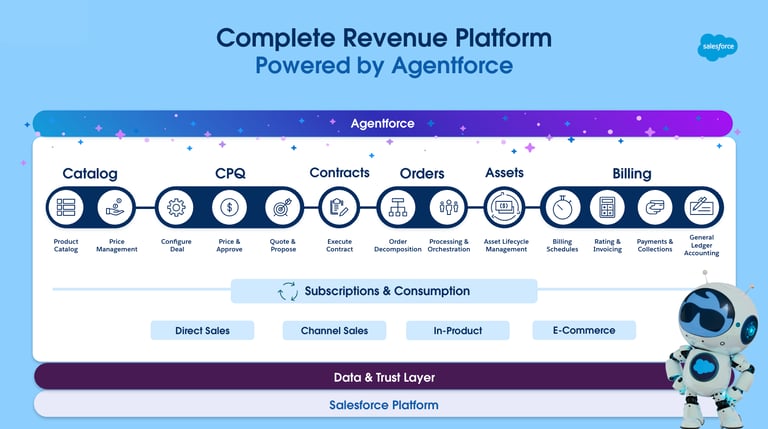
Salesforce’s newer Revenue Cloud platform introduces Revenue Lifecycle Management (RLM), a modern architecture designed to manage the entire revenue process - from product catalog and pricing to quoting, contracts, billing, and renewals.
This guide outlines a structured migration strategy from Salesforce CPQ (Steelbrick) to Revenue Cloud, including key stages, architectural considerations, and the role of Agentforce in the future of intelligent selling.
Why move to Revenue Cloud?
Salesforce Revenue Cloud is a complete revenue lifecycle management software platform built natively on Salesforce. It unifies every step of the revenue process — from product catalog management and pricing to quoting, contracting, order fulfillment, and invoicing. Whether you're selling subscriptions, usage-based services, or one-time products, Revenue Cloud ensures accuracy and consistency from the moment a customer sees a quote through to payment collection.
While Steelbrick CPQ has powered quoting for thousands of Salesforce customers, Revenue Cloud introduces several advancements:
Revenue Lifecycle Management (RLM)
Instead of focusing only on quoting, Revenue Cloud manages the entire revenue lifecycle.Modern Pricing Engine
Pricing Procedures replace complex CPQ price rules.Product Catalog Management (PCM)
A scalable catalog designed for subscriptions, usage pricing, and hybrid business models.Dynamic Revenue Orchestration
Automate and manage the entire order fulfillment lifecycle, bridging the gap between sales and delivery.AI-Driven Revenue Operations
Revenue Cloud integrates with Agentforce to support intelligent automation and guided selling.
Stage 1: Strategic Assessment and Readiness
Before migrating from Salesforce CPQ (Steelbrick) to Revenue Cloud, organizations must conduct a comprehensive assessment of their existing Salesforce CPQ (Steelbrick) environment. This stage establishes the migration baseline, documents the 'as-is' state, and identifies all CPQ features, pricing rules, product configurations, approval workflows, and integrations.
Product Catalog Complexity
Number of SKUs
Bundle structures
Product dependencies
Pricing Logic
Price Rules
Discount Schedules
Contracted Pricing
Configuration Rules
Product Rules
Selection Rules
Validation Rules
Integrations
ERP
Billing
Finance systems
Tax engines
Stage 2: Product Catalog Rationalization
Streamline and standardize Salesforce CPQ (Steelbrick) catalog for Salesforce Revenue Cloud (RCA/RLM). Identify duplicate SKUs, optimize bundles, and normalize product structures to reduce complexity. This ensures a cleaner, scalable catalog that accelerates quoting and supports multi-channel sales.
Stage 3: Pricing & Configuration Migration
Migrating Salesforce CPQ to Revenue Cloud involves re-architecting product configuration logic, bundles, and guided selling frameworks. Pricing rules, discount schedules, and automated procedures are rebuilt in Revenue Cloud for accuracy and scalability. This ensures a modern, future-ready CPQ platform that integrates seamlessly with Salesforce and supports faster, error-free quoting.
Stage 4: Quote Lifecycle Migration
Quote Lifecycle Management in the migration to Salesforce Revenue Cloud focuses on redefining how quotes are created, approved, versioned, and ultimately converted into orders. Legacy workflows from Steelbrick CPQ are redesigned using native automation capabilities within Salesforce Flow Orchestration along with event-driven triggers to create a more scalable and maintainable process.
The migration also accounts for active opportunities and in-progress quotes so that sales teams can continue working on open deals without interruption during the transition. In addition, related assets, subscriptions, and contracts are carefully aligned to ensure they support renewals, amendments, and the broader revenue lifecycle managed within Salesforce Revenue Cloud.
Stage 5: Integration Architecture Migration
Migrating integrations from Salesforce CPQ to Salesforce Revenue Cloud involves reconfiguring both inbound and outbound integrations to ensure seamless data flow between ERP, billing, subscription, and financial systems. Revenue Cloud’s composable APIs allow modular, event-driven integration, enabling real-time updates for pricing, quotes, and contracts. This approach reduces reliance on custom code, improves scalability, and ensures that all systems stay synchronized throughout the revenue lifecycle.
During the migration from Salesforce CPQ (Steelbrick) to Revenue Cloud, many organizations run both systems in parallel for a defined period. This parallel run allows teams to compare quotes, validate pricing accuracy, and ensure configuration logic behaves consistently in the new platform. It also enables thorough user acceptance testing (UAT) without disrupting ongoing sales operations. Once results are validated and confidence is established, organizations can safely transition fully to Revenue Cloud.
Stage 6: Parallel Run and Validation
Stage 7: Go-Live and Cutover
The Go-Live and Cutover stage marks the official transition from Salesforce CPQ to Salesforce Revenue Cloud. All Revenue Cloud quoting, pricing, and automation processes are enabled, while CPQ is decommissioned to avoid conflicts. Sales teams are supported with training, playbooks, and AI-guided tools to ensure smooth adoption. This stage finalizes the migration, delivering a unified, scalable, and future-ready revenue platform
Stage 8: AI Driven Revenue Operations
Agentforce can significantly enhance the capabilities of Salesforce Revenue Cloud by introducing intelligent automation across the entire revenue lifecycle. Integrated within the Salesforce ecosystem, Agentforce can act as an AI-powered assistant that helps sales teams configure complex quotes, recommend optimal pricing strategies, and automatically guide users through CPQ workflows. By analyzing historical deal data, contract terms, and pricing models, it can suggest the best product bundles, discounts, and contract structures in real time.
Beyond quoting, Agentforce can streamline downstream processes such as contract creation, billing readiness, and revenue forecasting. AI agents can monitor deal progress, flag approval risks, generate contract summaries, and even assist with renewal or expansion opportunities. When combined with Revenue Cloud’s CPQ, Billing, and Revenue Recognition capabilities, Agentforce helps organizations reduce manual effort, improve pricing accuracy, accelerate deal cycles, and deliver a more intelligent, data-driven revenue operation
Final Thoughts
Migrating from Salesforce CPQ (Steelbrick) to Revenue Cloud (RCA/RLM) transforms your quoting, pricing, and revenue management into a scalable, AI-powered platform. While the migration requires careful planning, effort, and investment, it ensures accurate pricing, seamless quote-to-cash workflows, and smooth integration with Salesforce. The result is a future-ready revenue platform that accelerates deal cycles, improves revenue visibility, and empowers sales teams with modern automation and Agentforce AI capabilities.
Support
info@cpqgurus.com
(408) 475-4180
© 2025. All rights reserved. CPQ GURUS is a specialized division of Clerisoft, Inc., dedicated to Salesforce Revenue Cloud consulting and innovation.